How to Handle Products for Maximum SEO Efficiency (eCommerce Focused)
After nearly 20 years in SEO, one of the biggest opportunities I still see on eCommerce websites is poor product lifecycle management.
Businesses either:
❌ Keep every discontinued product forever, creating thousands of low-value pages.
or
❌ Delete products in bulk, wiping out years of SEO equity overnight.
Neither approach is ideal.
Here’s the framework I use before making any decision.
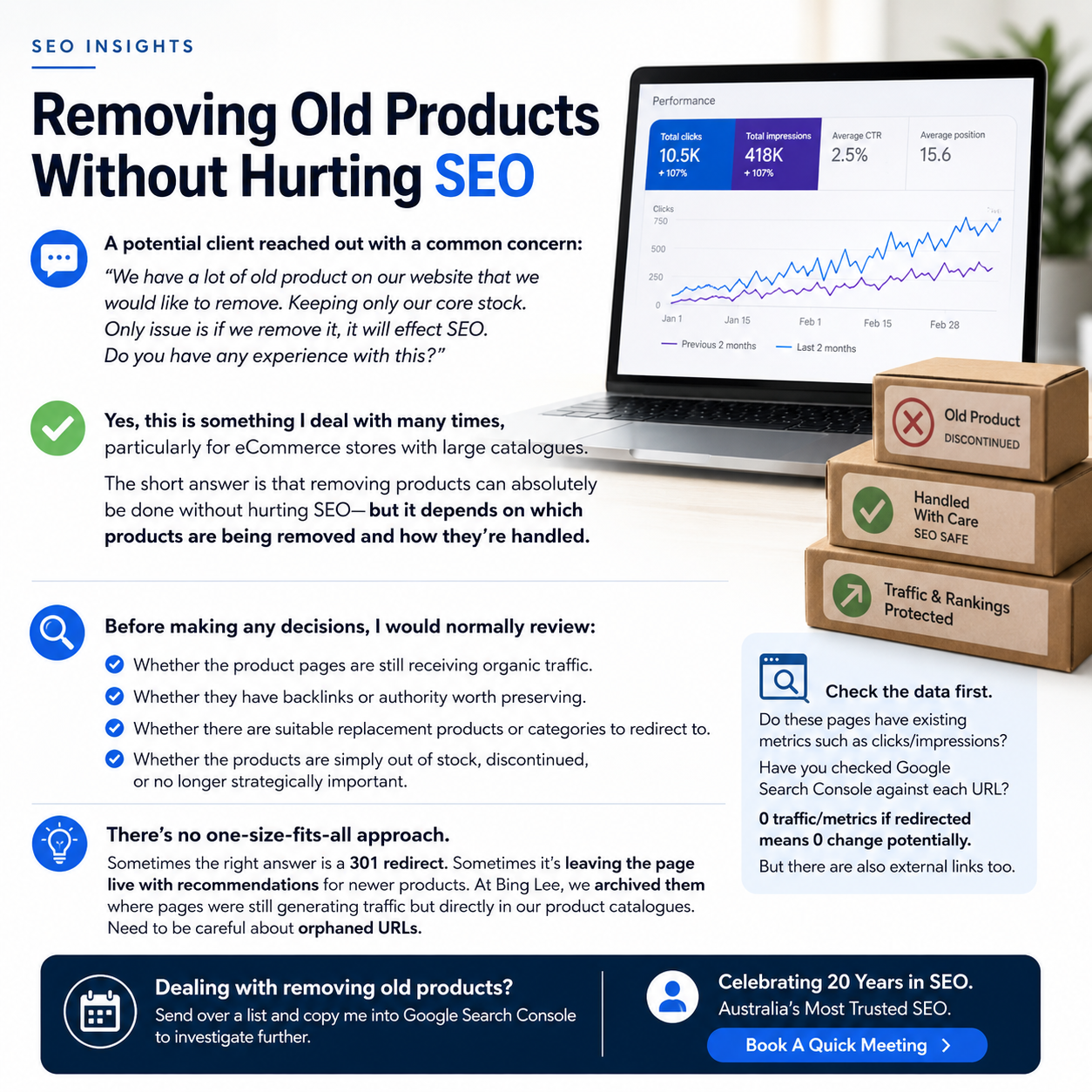
Before touching a product page, ask:
If Google is still sending traffic, think twice before removing it.
A discontinued product with quality backlinks still has authority.
Deleting it without a plan can throw away valuable link equity.
Keep Live
Archive
This worked extremely well on large catalogues I’ve managed over the years.
301 Redirect
Never redirect simply because you feel every deleted page needs a redirect.
If you archive products, make sure they’re still discoverable.
Link them from:
If Google can’t reach a page through internal links, its value can gradually diminish.
Every important product should receive contextual internal links from:
Internal links remain one of the most underutilised SEO opportunities in eCommerce.
Thousands of thin, duplicate or obsolete product pages consume crawl budget and dilute overall site quality.
A smaller, well-managed catalogue often performs better than a massive catalogue filled with neglected pages.
SEO isn’t about having the most pages.
It’s about having the right pages.
The best-performing eCommerce websites aren’t afraid to remove products.
They’re just extremely strategic about how they do it.
After working with retailers ranging from jewellery to electronics, supplements and workwear, I’ve found that careful product lifecycle management is often one of the quickest ways to improve organic performance without creating a single new page.
Sometimes the biggest SEO win isn’t publishing more content. It’s protecting the authority you’ve already built.