A practical Shopify SEO audit framework based on nearly 20 years of experience, covering technical foundations, collection structure, internal linking, content, Digital PR and AI visibility.
Most Shopify SEO audits are far too long, overly technical and filled with issues that may never influence revenue.
After almost 20 years working in SEO, I have learned that sustainable growth rarely comes from fixing everything at once. It comes from identifying the small number of opportunities that can make the biggest commercial difference, then executing those improvements properly.
I recently completed an SEO audit for an Australian health supplement and food brand operating on Shopify. The audit uncovered a series of opportunities that are common across thousands of eCommerce stores: canonical URL problems, weak collection architecture, duplicated product content, underused first-party data, untapped Digital PR opportunities and a content strategy that could better connect search demand with commercial products.
This article explains the framework I used, why each issue matters and how Shopify businesses can turn an SEO audit into measurable organic revenue growth.
A useful SEO audit should not begin with a 200-page export from a crawler.
It should begin with the business.
What products generate the highest margin? Which categories have the greatest growth potential? Which audiences are most valuable? What does the business want to be known for? Where is organic traffic already creating revenue?
Those questions help separate meaningful SEO work from technical busywork.
For example, a missing image alt tag on an unimportant page may be technically incorrect, but it is unlikely to outperform a well-planned collection page targeting a high-intent commercial search. Good SEO prioritisation is about understanding impact, not simply counting issues.
SEO recommendations should be grounded in real customer and performance data.
Google Search Console can reveal:
Google Analytics can then show what happens after the click:
Rankings matter, but rankings without clicks, engagement and revenue tell only part of the story.
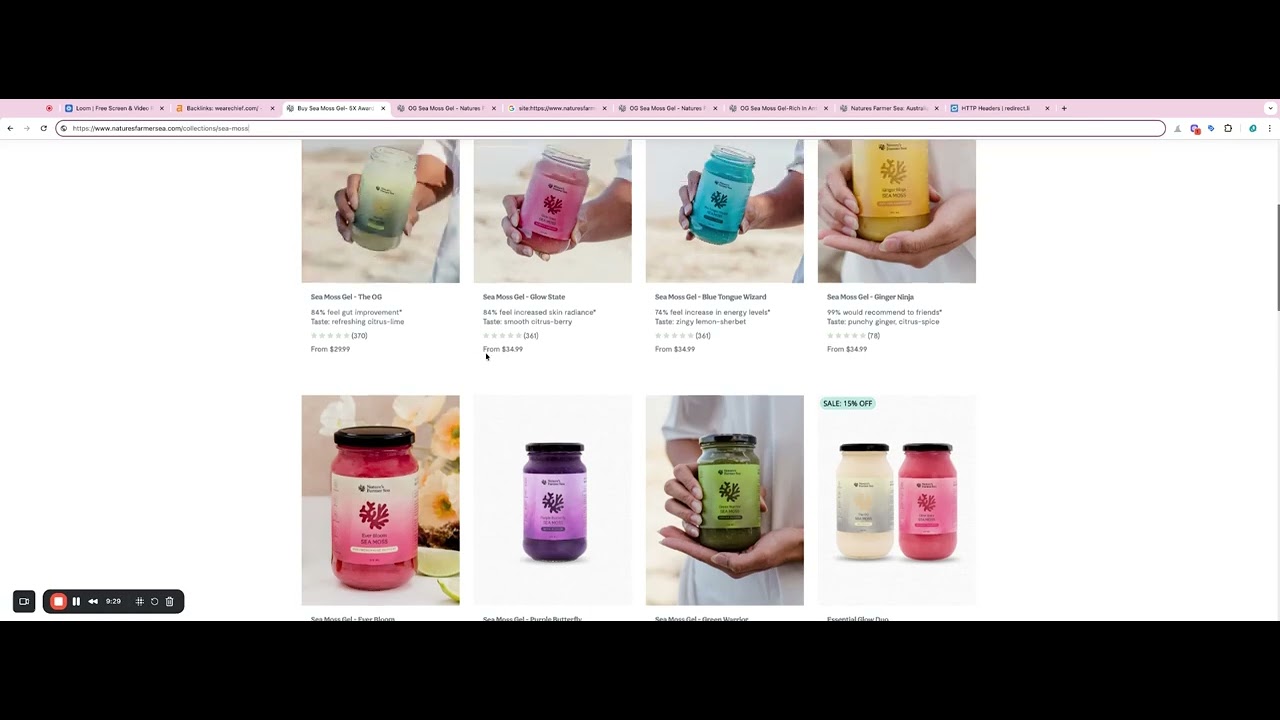
One of the most common Shopify SEO problems is internal linking to non-canonical product URLs.
A product may be accessible through a collection path such as:
/collections/sea-moss-gels/products/purple-butterfly-sea-moss-gel
However, Shopify may identify the preferred canonical version as:
/products/purple-butterfly-sea-moss-gel
The collection-based URL can still work for customers, but the canonical tag tells search engines that the shorter product URL is the preferred version.
When a website repeatedly links to the non-canonical version, it creates an avoidable disconnect between the URLs receiving internal links and the URLs the site wants indexed.
Where practical, internal links should point directly to the canonical product URL. This helps consolidate internal authority and creates clearer signals for search engines.
Internal links distribute authority throughout a website.
If a high-performing collection page earns backlinks or ranks strongly, it should pass that authority to its most important products through clean, crawlable links.
The anchor text also helps search engines understand the relationship between the collection and the product. This does not mean forcing the same keyword into every link. It means using natural, descriptive language that gives customers and search engines meaningful context.
A product should not rely only on the main navigation or a JavaScript-driven carousel to be discovered. Important products should receive links from relevant collections, blog articles, guides, comparison pages and supporting content.
Shopify stores often create multiple collections that target nearly identical search intent.
For example:
These pages may be useful from a merchandising perspective, but they can create confusion if each page uses similar titles, headings, copy and internal links.
The result is keyword cannibalisation: several pages competing for the same search intent without one clear page being established as the primary result.
Every important collection should have a distinct purpose. One page may target sea moss gels, another sea moss supplements, another sea moss capsules and another women’s health supplements. The language, content and internal linking should reinforce that difference.
Many Shopify stores organise collections around internal product language rather than customer demand.
A customer may not know the name of a branded product, but they may search for:
Collections should help the brand capture these broader commercial searches.
This is especially valuable when a product category has strong benefits but limited public awareness. SEO can introduce customers to the solution before they know the product name.
The goal is not to create a collection for every keyword. The goal is to map genuine customer intent to useful, commercially meaningful landing pages.
Shopify does not provide complete control over URL structure.
Collection URLs contain /collections/.
Product URLs contain /products/.
Blog URLs follow Shopify’s standard blog structure.
In a perfect world, a business might prefer a custom hierarchy such as:
/sea-moss/gels/purple-butterfly/
Shopify will not usually allow that structure natively.
That does not mean Shopify cannot perform well in organic search. It means the SEO strategy must work within the platform’s limitations.
The priority should be:
Platform limitations matter, but they should not become an excuse for avoiding the fundamentals.
Product handles should be readable and descriptive.
A vague handle may provide little context, while an unnecessarily long handle becomes difficult to manage.
A strong product URL usually includes the product type and a meaningful differentiator, such as:
/products/purple-butterfly-sea-moss-gel
or:
/products/original-sea-moss-gel-500g
Product size can be useful when separate product pages exist for different sizes, but it should not be added simply to make the URL longer.
URLs are only one signal. They should support the page rather than carry the full SEO strategy.
Ranking first is only part of the job.
A search result still needs to attract the click.
Product and collection titles should combine relevance with persuasion. Depending on the page, useful elements may include:
The brand name does not always need to occupy valuable title-tag space, particularly when the brand already appears elsewhere in the result.
Google Search Console can help identify pages with strong average positions but weak click-through rates. Those pages often represent fast opportunities for improvement.
Meta descriptions are not simply keyword containers.
A good description should help a customer understand:
Google may rewrite meta descriptions, but a strong original description still provides a better foundation and can improve how the result is presented.
The strongest descriptions are specific. Generic copy such as “Shop our range of high-quality products today” wastes an opportunity to communicate real value.
Duplicated product content is extremely common on Shopify.
Stores often reuse the same:
Some shared information is unavoidable, particularly when products use the same core ingredient. The problem appears when most of the visible page is repeated across multiple URLs.
Important products should include unique content that explains why that specific variation exists, who it is for, how it differs, how it tastes, how it is used and what questions customers commonly ask.
Unique content improves both search relevance and conversion.
Displaying the same reviews on every product may weaken customer confidence and reduce page uniqueness.
Where possible, reviews should relate directly to the product being viewed. Customers want to know whether people liked that flavour, format, size or use case.
Product-specific reviews also create natural language around the item, including vocabulary and questions that may not appear in the formal product description.
Sitewide testimonials can still have value, but they should not replace genuine product-level proof.
Informational blog content is useful, but it should not carry the entire SEO strategy.
A health brand may publish articles about women’s health, menopause, energy or nutrition while failing to create commercial landing pages for the same themes.
That creates a gap between education and purchase intent.
A well-structured benefit-led collection can help customers move from a problem or goal to an appropriate range of products. Examples may include:
These pages should be built responsibly, with accurate language and appropriate medical disclaimers where required.
The blog should be driven by real search behaviour rather than random publishing.
For a sea moss or health supplement brand, useful questions may include:
These topics can generate search traffic, but they also reduce uncertainty before purchase.
The strongest guides answer the question honestly, explain limitations and connect readers to relevant products only when the connection is genuinely helpful.
Brands often avoid topics that sound uncomfortable.
That can be a mistake.
Customers may already be seeing articles about iodine levels, contaminants, side effects, heavy metals or interactions. If the brand refuses to address those issues, less informed or less trustworthy sources may dominate the conversation.
A credible business should explain:
Transparent content builds trust. It may also attract citations and links because it contributes something useful to the wider discussion.
Publishing one article about sea moss and then moving to an unrelated topic will not create meaningful topical authority.
A stronger strategy groups related content around a core subject.
For example, a sea moss cluster could include:
These articles should link naturally to one another and to the relevant collection and product pages.
The result is a connected body of information rather than a collection of disconnected posts.
Technical SEO and content can improve relevance, but competitive rankings often require authority.
Digital PR can help a brand earn links and mentions from:
The goal is not to buy links from websites created solely for SEO.
The goal is to create stories, data, commentary and assets that journalists genuinely want to reference.
For established founders, strong customer stories, original research, sourcing transparency and expert partnerships can create powerful PR angles.
Original information gives publishers a reason to cite the brand.
Useful assets might include:
A brand does not need to become a university research institution. It does need to create something more valuable than another rewritten listicle.
Originality is increasingly important for both traditional search and AI-driven discovery.
A single well-planned content idea can become:
This approach improves consistency and makes content production more efficient.
It also allows the business to match different user preferences. Some people want to read. Others want to watch, listen or scan a short summary.
The brands winning attention today increasingly operate like media companies.
Useful visual content can strengthen a page and create additional search opportunities.
A guide about eating for menopause, for example, could include:
Those assets may appear in image results, video results, standard search features and AI-generated answers.
They also improve the experience for customers who may not want to read a long wall of text.
Search behaviour is expanding beyond traditional Google results.
Customers now ask questions through ChatGPT, Gemini, Microsoft Copilot, Perplexity and other AI tools.
There is no magic switch for AI visibility. The same foundations still matter:
Content should make important answers easy to extract, but it should still be written for people.
AI optimisation should strengthen the SEO strategy, not replace it.
The final question is not whether the business fixed a canonical tag or published another article.
The final question is whether organic search is creating more qualified traffic, customers and revenue.
A practical Shopify SEO measurement framework may include:
Not every benefit appears immediately in revenue, particularly Digital PR and brand-building work. However, every major activity should still connect to a clear commercial objective.
Most of the opportunities in this audit fall into three connected areas.
The site must be crawlable, indexable and internally consistent. Canonicals, internal links, URL handling, duplicate content, metadata and site architecture all contribute to that foundation.
The site must match how customers search. Collection pages, product pages, guides and supporting media should work together rather than compete or exist in isolation.
The brand must earn trust beyond its own website. High-quality editorial links, original research, founder expertise and credible mentions can strengthen the entire domain.
When these three areas work together, SEO becomes far more powerful than any single tactic.
A strong Shopify SEO strategy is not built by installing another app or publishing hundreds of generic articles.
It is built by understanding the business, using first-party data, removing technical friction, creating pages around genuine search intent and earning authority through work worth referencing.
Shopify has limitations, but those limitations do not prevent meaningful organic growth.
The businesses that win are usually the ones that execute the fundamentals more consistently, create better information and connect every part of the website to the customer journey.
After almost 20 years in SEO, that remains the core of the work: make it easier for search engines to understand the business and easier for customers to find, trust and buy from it.
Omega Digital provides senior SEO consulting, technical SEO, eCommerce strategy, Digital PR and AI search optimisation directly with Andrew Glyntzos, an Australian SEO professional with almost 20 years of experience.
Our work focuses on commercial outcomes, transparent advice and the practical improvements most likely to generate sustainable organic growth.