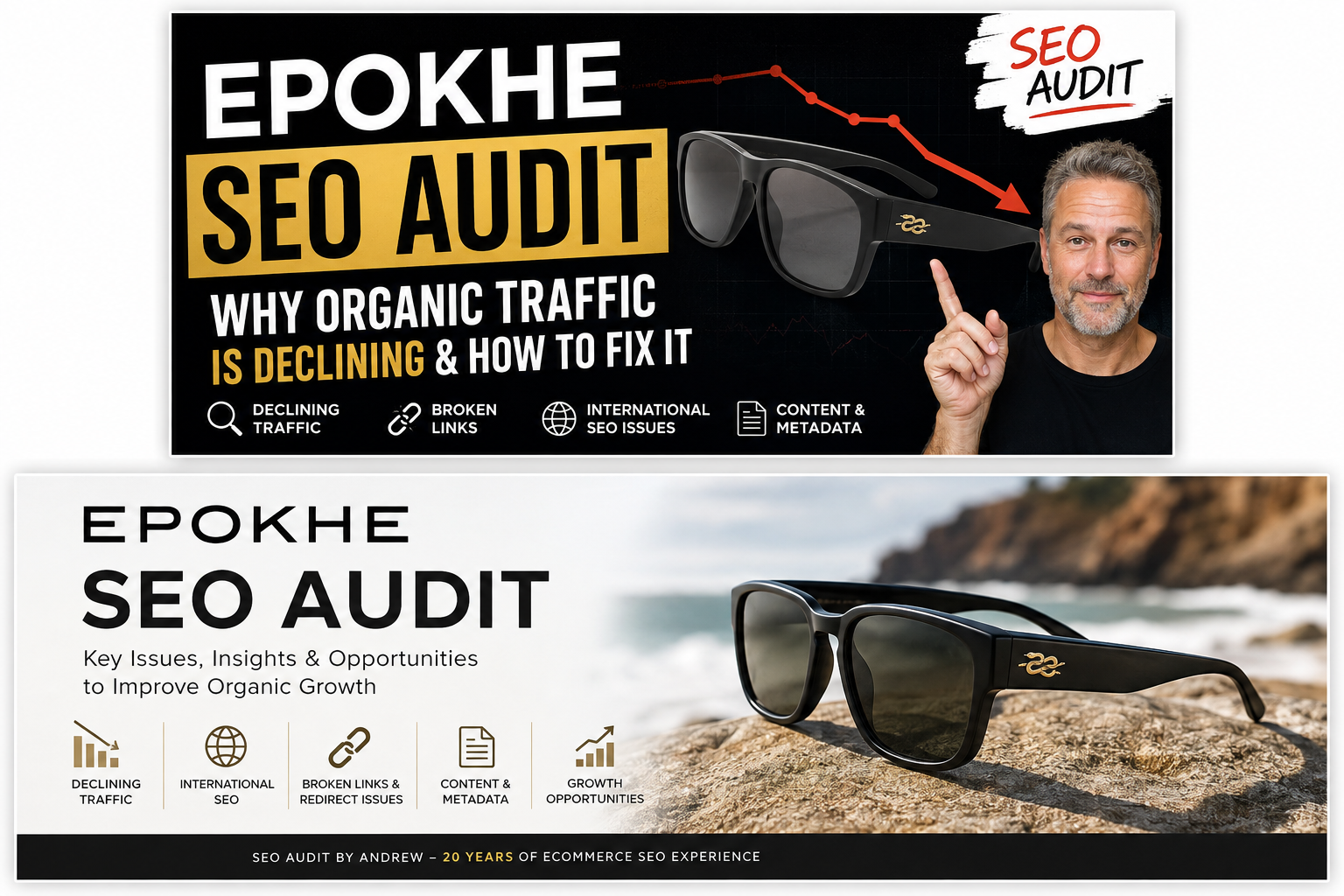
I have been working in SEO for 20 years and have worked across many national and international eCommerce campaigns. Over that time, I have helped retailers achieve first-place rankings for highly competitive keywords such as “workwear”, “work boots”, “work clothes” and “polarised sunglasses”.
Based on what I have reviewed so far, I absolutely believe there is a significant amount of untapped SEO potential for Epokhe.
This is not intended to be a complete technical audit. I am currently looking at the website and third-party SEO data. To properly understand everything that is happening, I would also need access to Google Analytics, Google Search Console, Shopify and the wider business strategy.
However, there are already several important issues that stand out.
According to the third-party data I reviewed, Epokhe’s estimated organic traffic and organic traffic value have been declining since approximately November 2023.
The decline becomes even more noticeable when looking specifically at Australian organic traffic, particularly from around December 2024.
The important question is: why has this happened?
There is rarely one single reason for an organic decline. Usually, it is a combination of technical problems, content limitations, website structure, international targeting and lost external authority.
In Epokhe’s case, I believe all of these areas need attention.
A large percentage of Epokhe’s current organic search traffic appears to be branded.
That means people are searching for Epokhe because they already know the brand.
Branded traffic is obviously valuable. However, branded searches can be generated by many different activities, including PR, social media, paid advertising, sponsorships, influencers and offline brand awareness.
The real SEO growth opportunity is non-branded search.
This means reaching people who do not already know Epokhe exists.
Someone might search for:
They are not necessarily looking for Epokhe. They are looking for a product, style, feature or solution.
When those people discover Epokhe through Google or an AI platform and then purchase, that is where SEO starts creating substantial new revenue.
At the moment, improving Epokhe’s non-branded organic visibility should be one of the highest priorities.
The current international domain and subdomain structure is one of my biggest concerns.
Epokhe appears to be using different subdomains and Shopify Markets versions for the United States, Europe, New Zealand, Indonesia and other locations.
There are several ways to structure an international website, and every approach has pros and cons.
For example, large brands may use:
.com.auFrom my experience, subdomains often make SEO more complicated than it needs to be. They can split authority, create targeting problems and make it more difficult to build the strength of the main website.
Australia appears to be Epokhe’s primary market. If that is the case, I would seriously consider whether the Australian website should operate from a country-specific .com.au domain.
The existing .co or international domain could then potentially support international expansion, including the United States and other regions.
However, I would not make a final recommendation without first understanding:
This needs to be discussed properly because changing domains or international targeting without a clear strategy can quickly create more SEO problems.
Epokhe has earned media coverage and external links from major publications.
That is incredibly valuable.
External links remain a major part of how websites build authority across traditional search engines and AI-powered discovery platforms.
The problem is that some of these publications appear to be linking to Epokhe’s US subdomain rather than the primary Australian website.
This means the US website version may be receiving the SEO authority, even though Australia is currently the main market and the main source of organic traffic.
That is another reason I am concerned about the current subdomain structure.
When Epokhe receives a valuable media mention, we want that authority flowing into the most commercially important version of the website.
We do not want the authority being fragmented across several different subdomains and international website versions.
I also found external websites linking to Epokhe URLs that now return a 404 not found error.
This is a significant lost opportunity.
When another website links to Epokhe, that link can transfer authority and help improve organic rankings. If the linked page has been removed and now returns a 404 error, much of that value is effectively being wasted.
It also creates a poor customer experience.
Someone could be reading an article about Epokhe, click the link because they are interested in purchasing and then land on a broken page.
That person may have been a potential sale.
These broken URLs should either be:
Where possible, reinstating a valuable URL can sometimes be the best solution. However, that decision depends on the page, its existing links and the content that originally appeared there.
Another issue I discovered is that certain URLs appear to redirect when clicked normally, but the original linked URL still returns a 404 when it is tested or crawled directly.
This is a tricky problem because everything can appear to be working on the surface.
A customer clicks the link and eventually reaches a live page.
However, Google may crawl the original URL, encounter the 404 error and fail to properly transfer the authority from the external link.
That means Epokhe may be losing domain authority and page authority without it being obvious to the person managing the website.
The redirect pathways need to be crawled and tested properly. We should not assume a redirect is working simply because clicking it in a browser eventually opens a page.
Another major opportunity is Epokhe’s page optimisation.
Some collection pages currently use very vague page titles and headings.
For example, a collection page may simply use the word:
Polarised
Polarised what?
When Google, an AI platform or a potential customer looks at the page, the topic is not immediately clear.
A stronger heading might be:
Polarised Sunglasses
Or:
Polarised Eyewear Collection
This provides much more context.
The primary page heading should also generally be an H1, rather than an H2. I often explain the H1 as being similar to the main headline of a newspaper article. It tells the reader and the search engine what the page is primarily about.
The meta title and meta description also need improvement.
These are often what people see when the page appears in Google’s search results. The wording should contain relevant keywords while also giving people a reason to click.
Instead of simply displaying “Polarised”, the result could communicate:
The current titles and descriptions are not doing enough to support either rankings or click-through rates.
Improving them across the website could create a meaningful improvement in organic visibility.
I could not easily find a dedicated blog, journal or educational content section on the website.
That is a substantial missed opportunity.
Collection and product pages are important, but they cannot realistically target every question or topic being searched by Epokhe’s potential customers.
This is where long-form content becomes valuable.
Epokhe could create useful, interesting articles such as:
List-style articles, educational guides and question-based content can be incredibly powerful.
They allow Epokhe to expand its website architecture and create pages that directly match what potential customers are actively searching for.
These articles can generate organic traffic, strengthen the collection pages through internal links, support AI visibility and ultimately contribute to revenue.
Content should not be created merely to publish more words.
It needs to answer real customer questions, demonstrate Epokhe’s expertise and naturally guide people towards the relevant products and collections.
The product-page breadcrumbs also need attention.
A stronger breadcrumb structure would generally look something like:
Home → Main Collection → Product Name
The collection page should be included because collection pages will often generate more organic search traffic than individual product pages.
For example, a product should ideally link back to its most relevant collection, such as polarised sunglasses or men’s sunglasses, rather than only linking back to the homepage.
This helps customers navigate the website, but it also helps Google understand the relationship between the product and the broader collection.
Internal linking is one of the most controllable parts of SEO.
The website should be deliberately directing authority towards the pages with the greatest potential to generate organic traffic and revenue.
When reviewing the international page settings, I could see general English versions and other international variations, but I could not identify a clear Australian English version.
This raises additional questions around Shopify Markets, language targeting and hreflang implementation.
Why is there a New Zealand version?
Why is there an Indonesian version?
Are the products different, or is it only the currency and pricing that change?
There may be legitimate commercial reasons for the current setup. However, from an SEO perspective, each additional market needs to have a clear purpose.
Creating many near-identical international versions can lead to:
The international structure is likely to be one of the most important areas to resolve.
If this foundation is not working properly, it will continue to limit the results of every other SEO activity.
The first stage of an Epokhe SEO campaign would focus heavily on the foundation.
My initial priorities would include:
This is not simply about getting more traffic.
The objective is to attract more potential customers who are actively looking for the products Epokhe sells but do not yet know the brand exists.
Despite the current organic decline, I see substantial potential.
Epokhe already has a recognised brand, strong products, media coverage and an established customer base. The opportunity is to better connect that existing brand authority with the technical and content foundations required to perform across Google and AI search.
The website is currently losing authority through its international structure, broken pages, external links and vague optimisation.
These issues are fixable.
Once the technical foundation is corrected, Epokhe can begin expanding into non-branded searches, publishing useful content, strengthening its collection pages and reaching entirely new customers.
After 20 years in SEO, I have seen these types of issues across many retail and eCommerce websites.
The good news is that the problems also represent opportunities.
There is a significant amount of organic growth potential available to Epokhe. The next step is to properly understand the business priorities, access the first-party analytics and develop a strategy that supports both the Australian market and the company’s international ambitions.