Are Ideal Client Profiles still marketing gold—or have they become workshop fiction?
That question came up during a recent strategy discussion with the Head of Strategy at an accounting and insurance business. The team was developing its Ideal Client Profiles, or ICPs, to help us better understand the direction of the business before expanding its website and content strategy.
It was an excellent question because the business did not yet have enough reliable search and website data for us to treat any profile as established fact.
My honest view is simple:
ICPs are incredibly valuable when they are informed by modern search, first-party and commercial data. They are rubbish when they are invented in a workshop and treated as permanent truth.
Thinking you serve a particular type of customer does not necessarily mean you actually do. It also does not mean that customer is profitable, stays with you, buys multiple services or represents the best opportunity for future growth.
The answer is not to abandon ICPs. It is to make them living, evidence-based models.
An Ideal Client Profile describes the type of customer or organisation that is the strongest fit for a business.
A useful ICP should help answer questions such as:
An ICP is often discussed separately from a buyer persona. Traditionally, the ICP defines the best-fit customer or organisation, while a buyer persona describes the individual involved in the decision.
In reality, those distinctions often blur. The label matters less than whether the profile improves your marketing, website, customer experience and commercial decisions.
Many traditional profiles are created in a boardroom using assumptions that sound specific but offer little practical value.
For example:
“Sarah is 42, owns a business, has two children, drives an SUV and enjoys coffee.”
It sounds detailed. But does it tell us why Sarah is searching, what problem she needs solved, how urgent that problem is or why she would choose your business?
Not really.
A profile becomes dangerous when assumptions are presented as certainty. Marketing teams may then build campaigns, website pages and customer journeys around an audience that does not exist—or one that does exist but rarely converts into a valuable client.
| Static workshop ICP | Living, data-led ICP |
|---|---|
| Built mainly from assumptions | Built from observed behaviour and commercial outcomes |
| Focused on broad demographics or firmographics | Focused on problems, triggers, intent and value |
| Treated as a completed annual document | Regularly reviewed as evidence changes |
| Measures leads or traffic | Connects enquiries to revenue, retention and profitability |
| Forces customers into one broad profile | Allows for multiple needs, stages and journeys |
Static ICPs create the illusion of understanding. Living ICPs help a business learn.
Consider an accounting and insurance business.
A business owner worried about cash flow, a parent wanting to protect their family and an established owner preparing for succession may appear similar demographically. They could be the same age, live in the same suburb and have comparable incomes.
However, their needs are completely different.
| Illustrative client situation | Immediate problem | Likely information need | Appropriate next step |
| Growing business owner | Cash flow, tax obligations or financial visibility | Practical guidance about improving control and planning growth | Accounting or advisory consultation |
| Parent protecting a family | Financial exposure if something goes wrong | Clear explanations of protection options and common risks | Insurance needs discussion |
| Established owner planning an exit | Succession, valuation, tax and continuity | Coordinated guidance across business and personal considerations | Strategic planning meeting |
Their search language, urgency, trust requirements, content needs and ideal website journeys will differ.
This is why a single generic profile often fails. A business may need several ICPs organised around life stage, business stage, trigger event and the problem the person is trying to solve.
Demographic and firmographic information still has value. Industry, business size, location, income, family stage and decision-making authority can help qualify an audience.
However, search behaviour frequently gives us something more immediate: intent.
Someone searching for “how to improve business cash flow” is revealing a problem.
Someone searching for “key person insurance for a small business” is revealing a more specific commercial risk.
Someone comparing “business succession planning advisers” may be much closer to choosing a provider.
These searches can help us understand:
This information should feed directly into SEO, content and website information architecture.
Yes—but there is an important qualification.
You need enough reliable data.
Reverse-engineering an ICP does not mean trying to identify individual website visitors. It means analysing aggregated search, behavioural and commercial patterns to understand the audiences engaging with the business.
Several first-party sources can contribute different pieces of the picture:
Google Search Console shows the searches for which a website is appearing, the pages customers are selecting and where visibility is growing or declining.
It can reveal the language people use, unexpected areas of demand and the difference between informational and commercially focused searches.
GA4 can help show which landing pages attract engaged visitors, which paths people take through the website and which content contributes to enquiries.
Traffic alone is not the objective. We need to understand whether the traffic is moving towards a meaningful business outcome.
What people search for after arriving on a website can reveal missing navigation, unclear terminology and services or questions that are difficult to find.
Internal searches can be some of the clearest expressions of what an existing visitor wants from the business.
Form responses, emails, phone calls and meeting notes provide context that analytics platforms cannot.
They tell us why a person reached out, what nearly stopped them, which concerns matter most and how they describe the problem in their own words.
CRM and financial data help determine whether an enquiry became a client and whether that client was valuable.
Depending on the business, useful signals may include:
This distinction matters because search data tells us what the market wants, but it does not necessarily tell us who the best client is.
The real gold comes from joining search behaviour with commercial client data.
It is possible to rank highly for a topic, generate substantial traffic and still attract the wrong audience.
It is also possible for a lower-volume search to produce fewer but far more valuable enquiries.
That is why SEO performance should not stop at rankings, clicks or sessions. The strongest model connects:
When those connections exist, ICPs become more than marketing documents. They can guide investment across SEO, content, paid media, sales and customer experience.
When there is limited data, do not invent certainty.
Start with hypotheses.
Use the knowledge held by business owners, client-facing staff, advisers and sales teams to document the most likely audiences, problems and trigger events. Then treat those initial ICPs as questions to test—not conclusions to defend.
From there:
Once useful content begins ranking and attracting the right visitors, the resulting first-party data helps the business understand more of the customer journey and the experience people expect.
The content generates data, and the data improves the content.
An ICP should not sit in a presentation and disappear after a marketing workshop.
It should influence how the website works.
For SEO and content strategy, ICP insights can help determine:
The goal is not to force every customer into a funnel. It is to create logical pathways that allow different people to recognise their situation, find relevant information and take the next appropriate step.
This is one reason strong SEO cannot be separated from customer experience. A page may rank first, but it will still fail if the visitor cannot see that the business understands them.
Apple provides a useful consumer example.
Much of its marketing does not begin with technical complexity. It leads with the experience: what the product enables someone to create, communicate or achieve.
The technical specifications are available for customers who need them, but they support the outcome rather than replace it.
B2B businesses can apply the same principle.
Your customer may need accounting, insurance, SEO, software or consulting expertise. However, that is not always the outcome they are buying.
They may be buying:
A strong ICP helps connect the technical service to the outcome the customer values.
Customer discovery no longer follows one predictable Google journey.
People may discover a business through Google, ask ChatGPT to compare their options, watch a YouTube video, check LinkedIn, read reviews and return directly when they are ready to enquire.
As I discussed in SEO Has Evolved: Welcome to the Era of Search Everywhere Optimisation, the objective is not simply to rank on one platform. It is to be visible and trusted wherever potential customers look for answers.
A modern ICP should therefore consider:
Google Search Console remains extremely valuable, but it is one window into an increasingly fragmented discovery journey.
Businesses can use the following process to create profiles that improve over time.
Do not define “best” by revenue alone. Consider profitability, longevity, results achieved, service fit, referrals, ease of collaboration and future potential.
What changed before they contacted you? A cash-flow problem, new regulation, growth stage, family event, declining performance or strategic opportunity often provides more insight than age or job title.
Review search queries, enquiries, sales calls, emails, reviews and client interviews. Use the words customers actually use rather than relying entirely on internal industry terminology.
Identify what the person needs to know at each stage, from recognising the problem to comparing providers and making contact.
Connect relevant educational content, service pages, proof and calls to action. Each important audience should have a clear journey without creating thin or repetitive pages.
Where possible, record which searches, pages and channels produce qualified enquiries, revenue, retention and cross-service opportunities.
Revisit the profiles quarterly or at least every six months. Markets change, services evolve and the customers a business wants may not be the customers it is currently attracting.
Yes. Ideal Client Profiles remain useful when they are based on real customer behaviour, first-party data and commercial outcomes. Static profiles based mainly on assumptions can quickly become inaccurate and misleading.
Useful sources include Google Search Console, GA4, internal website searches, enquiry forms, sales conversations, CRM records, client profitability, retention, service usage and direct customer feedback.
SEO data can reveal customer problems, language, intent and content demand. It becomes substantially more valuable when connected with CRM and revenue data that shows which enquiries become strong clients.
There is no universal number. Most businesses need enough profiles to represent genuinely different needs and customer journeys without creating dozens of artificial variations. Three to five evidence-based profiles can be a practical starting point for many businesses.
An ICP should be treated as a living model. Review it whenever services, markets or customer behaviour change, with a structured review at least every six months.
After 20 years in SEO, I have traditionally treated ICPs as secondary to search behaviour and what customers genuinely find valuable.
I try to remain a perpetual student of the person making the decision—and of the people we are best placed to help.
Data, intuition and human experience belong together.
An ICP should not replace experience or judgement. It should organise what the business believes, expose where evidence is missing and improve as more customers interact with the brand.
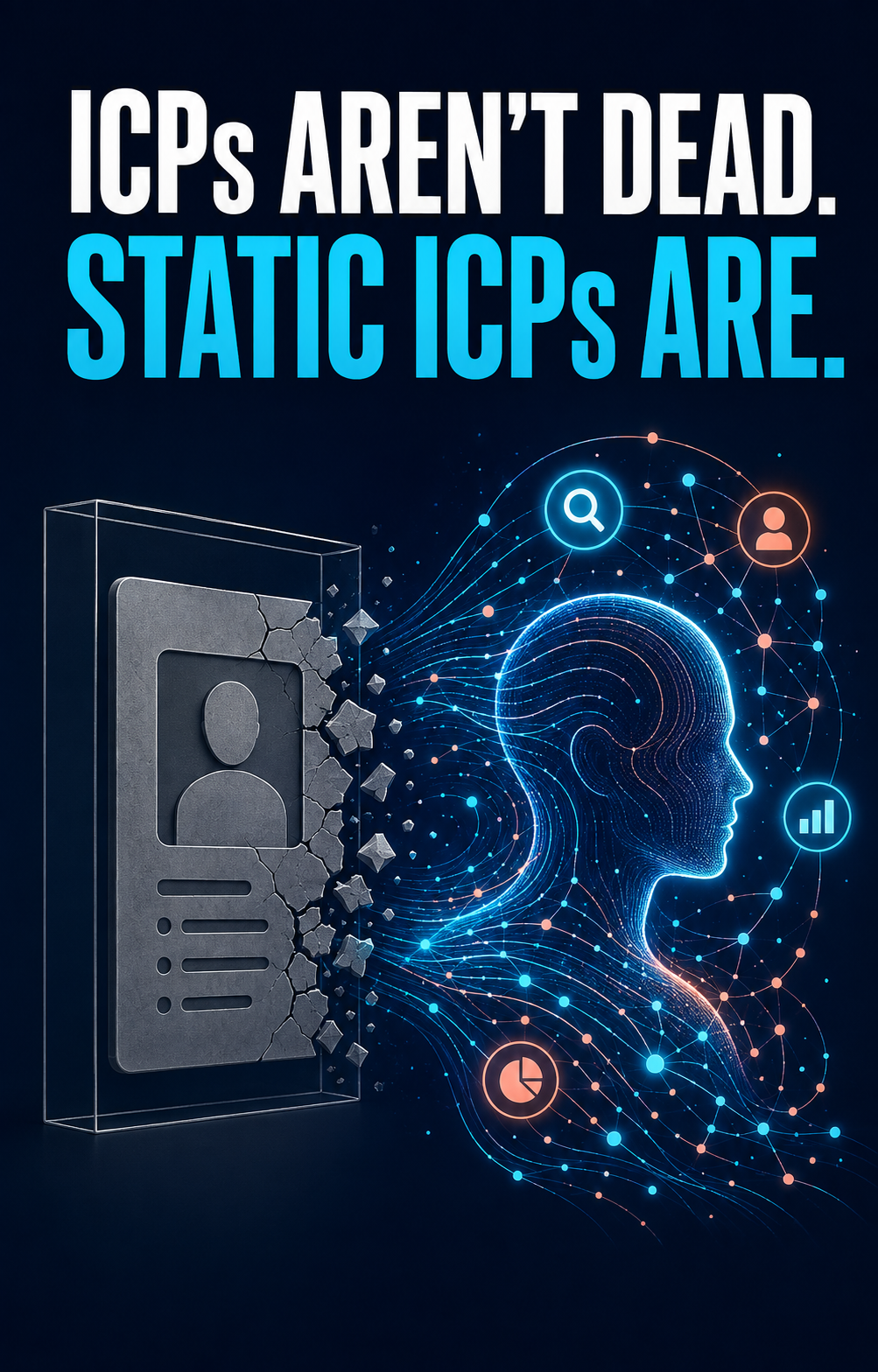
ICPs are not dead.
Static ICPs are.
If your website attracts traffic but does not consistently produce the right enquiries, the issue may extend beyond keywords.
Your information architecture, content, user journeys and measurement may not yet reflect the audiences most valuable to your business.
Omega Digital provides senior SEO strategy, content marketing and SEO oversight with direct access to Andrew Glyntzos and 20 years of experience.
Contact Omega Digital to discuss how your search data, first-party insights and commercial goals can become one connected growth strategy.