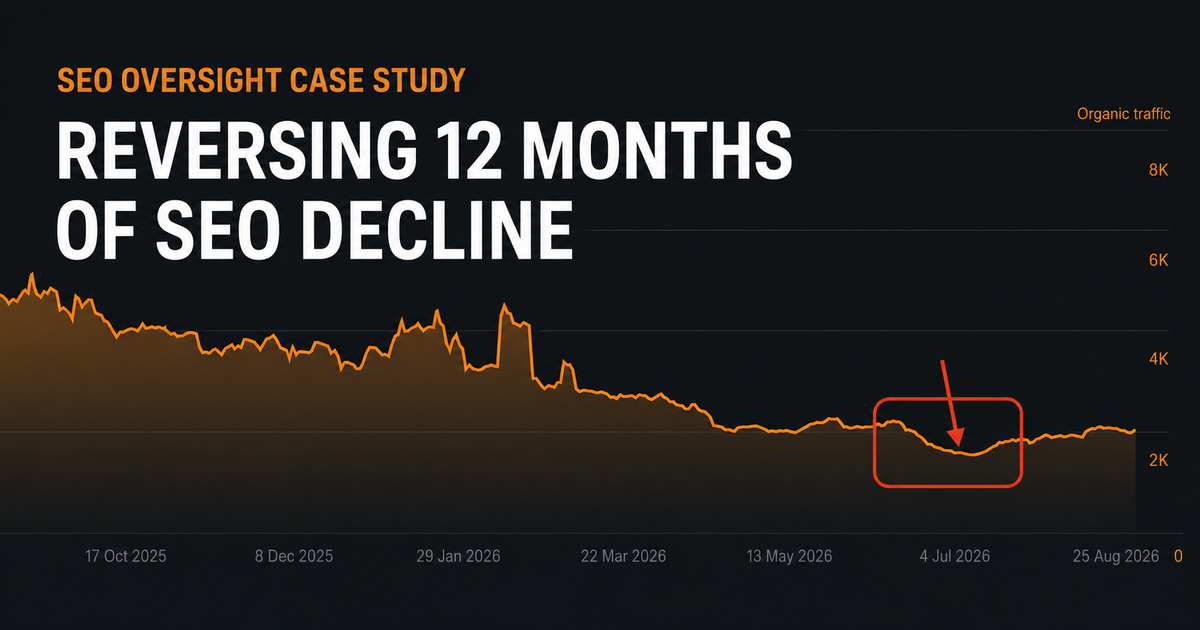
The red box on the graph marks the moment a former client called me in June 2026 and said:
“Andrew, we need your SEO help.”
We had finished working together on good terms in 2024. But by the time they returned, their website had suffered more than 12 months of consistent organic traffic and keyword ranking losses.
Their Google Business Profile listings also needed protection.
They initially returned through Omega Digital’s SEO Oversight Service, which provides businesses with senior, independent oversight of their existing SEO strategy.
Now, we are turning the ship around.
A sustained loss of organic visibility is rarely the result of one isolated technical error.
In this case, the decline was being driven by several issues that had accumulated across the website:
Individually, some of these issues may appear relatively minor. Combined, they can gradually weaken a website’s relevance, authority and overall search visibility.
One of the most significant problems was the enormous number of internal links pointing to product and diamond URLs that had little or no search demand.
More than 500,000 internal links were being generated across the website.
Many of the destination pages were already canonicalised to other URLs, meaning the website was repeatedly directing search engines towards pages that were not intended to rank independently.
This created unnecessary crawl paths, diluted the internal linking structure and made it more difficult for search engines to identify the pages that genuinely mattered.
We removed these crawl paths while the broader product and diamond architecture was reviewed.
This was not about removing valuable products from the website. It was about preventing programmatic page bloat and ensuring the site’s internal authority flowed towards commercially important pages.
Nothing gets my goat more than broken internal links.
Internal links should help customers and search engines move through a website logically. When they lead to missing pages, redirect chains or irrelevant destinations, they weaken both the customer experience and the website’s structure.
Broken external links can also reduce trust and leave previously useful content pointing towards outdated resources.
We identified and repaired broken links while reviewing whether each link still supported the purpose of the page.
The website was also targeting the wrong keywords with the wrong pages.
This created mixed relevance signals and caused multiple pages to compete for similar search terms.
Rather than helping the website rank more broadly, this internal keyword cannibalisation made it harder for Google to determine which page should appear for an important search.
We began remapping search intent across the website so that every priority keyword had a clear primary destination.
This included:
The objective is not to force every possible keyword onto a page. It is to give each important page a clear and defensible purpose.
The brand had gone several years without meaningful Digital PR activity.
We have since secured two authoritative editorial links to strengthen the website’s external authority and broader brand signals.
Good Digital PR is not simply about collecting backlinks.
Relevant media coverage can help customers, journalists, Google and AI platforms understand:
These third-party mentions are particularly important as search becomes increasingly focused on recognised brands and entities.
The website did not have breadcrumbs.
Breadcrumbs provide customers with a clear path through a website while helping search engines understand the relationships between its categories, subcategories, products and content.
We restored this missing layer of navigation and supported it with the appropriate structured data.
Schema can help label these relationships, but schema alone cannot repair a confusing website. The underlying information architecture still needs to make sense.
Some of the website’s strongest historical content had been left to age.
Before blindly publishing more articles, we identified previously successful pages with the potential to regain lost rankings and traffic.
These pages are being updated with:
Creating new content is still part of the strategy, but every article needs a defined purpose.
The new editorial plan is focused on building national brand awareness rather than publishing content simply to satisfy a monthly blog quota.
As an established Brisbane business, local search remains an important source of qualified customers.
The campaign therefore includes strengthening the brand’s visibility across local organic searches and its Google Business Profile listings.
This involves protecting the consistency of important business information, improving the connection between local landing pages and Google Business Profiles, developing Brisbane-relevant content and monitoring changes that could affect local visibility.
The national and local strategies are designed to support each other—not compete.
Some of the improvements are not flashy.
We are returning to the fundamentals with:
A meta title should not simply contain a keyword. It should give the right searcher a compelling reason to choose that result.
These fundamentals remain important regardless of how dramatically the search landscape changes.
YouTube video content is now part of the wider search strategy.
Customers do not discover businesses through Google’s traditional blue links alone. They may begin with ChatGPT, watch a YouTube video, compare Google reviews, visit a Google Business Profile and then return directly when they are ready to enquire.
The strategy needs to support that entire discovery journey.
The client has already confirmed three new engagement ring sales originating from ChatGPT.
That does not mean AI has replaced Google or that the campaign is finished. It shows that customer discovery is becoming more fragmented—and that AI visibility can now produce genuine commercial outcomes.
Entity SEO is not one tactic or one piece of schema.
It is the cumulative effect of technical SEO, useful content, credible media coverage, local relevance, video, reviews, consistent business information and genuine expertise all telling search platforms the same story.
Schema can help search engines label a business.
It cannot manufacture a real reputation.
Brands that invest in becoming known, trusted and genuinely useful will be in a stronger position across both Google and AI-driven discovery.
Those mass-producing pages for keywords no customer cares about may find the next era of search far less forgiving.
We are not going to declare a complete recovery after only a few weeks.
The immediate objective is to stop the repeated losses, stabilise visibility and repair the foundations required for sustainable growth.
From there, we can continue building authority, improving national visibility, strengthening Brisbane searches and increasing the number of customers discovering the brand through Google, YouTube and AI platforms.
There are many exciting things being tested within this campaign.
And we are only getting started.
If your business already has an internal marketing team, SEO agency or digital provider, you may not need to replace them.
You may simply need an experienced SEO professional reviewing the strategy, validating the work and ensuring priorities remain connected to traffic, enquiries and real revenue growth.
Learn more about Omega Digital’s SEO Oversight Service and receive direct guidance from Andrew Glyntzos, an Australian SEO specialist with 20 years of experience.
AI For the Win: