What if the most powerful marketing strategy for your small business wasn’t creating more content, but documenting the work you’re already doing?
One of the things I absolutely love about helping businesses grow is showing them how to combine SEO, social media and storytelling to build something far more valuable than website traffic.
Brand influence.
I call this the Small Business Influencer Mindset.
And no, I’m not suggesting every small business owner needs to become a TikTok celebrity, dance in front of a camera or accumulate millions of followers.
I’m talking about becoming an influential and trusted voice within your industry.
Someone people recognise, remember, recommend and actively search for.
After almost 20 years working in SEO, I’ve become increasingly passionate about helping businesses look beyond rankings and traffic.
Because SEO shouldn’t exist in isolation from your brand-building activities.
In fact, some of the most exciting opportunities come from combining search intent, genuine expertise, original storytelling and documentary-style content.
Here’s how I would approach it.
Imagine receiving a phone call tomorrow.
It’s Channel 9.
They love what your business does and want to produce a documentary series about your company.
You’re the star of the show.
What would you film?
What would your first episode cover?
Would you take viewers behind the scenes? Introduce your employees? Explain how your products are made? Show customers how you solve their problems?
Would you document the challenges you encounter, the decisions you make and the results you achieve?
Now here’s my question.
Why are you waiting for Channel 9?
You already have the subject matter.
You already have the expertise.
You already have the stories.
And most of us already have a perfectly capable video camera sitting in our pockets.
Your smartphone.
I would encourage small business owners to start documenting their everyday activities.
If you’re a builder, film your projects.
If you’re a plumber, explain the problems you’re solving.
If you’re a jeweller, document the process of designing and creating a beautiful engagement ring.
If you’re an accountant, share the questions clients regularly ask you, without revealing confidential information.
If you’re a business consultant, share your experiences, challenges and professional observations.
Not every video needs expensive production equipment or a professional editing team.
Sometimes the most interesting content is the authentic, unscripted material that demonstrates your knowledge.
Stop thinking that every piece of content needs to be a carefully scripted advertisement.
Instead, ask yourself:
What would someone genuinely interested in my industry find fascinating about what I do every day?
That’s where your storytelling begins.
Now, let’s connect this documentary approach to SEO.
This is where I believe small businesses have a fantastic opportunity to differentiate themselves from competitors producing generic blog content.
Google already provides valuable clues about the topics people are researching.
You can explore these through:
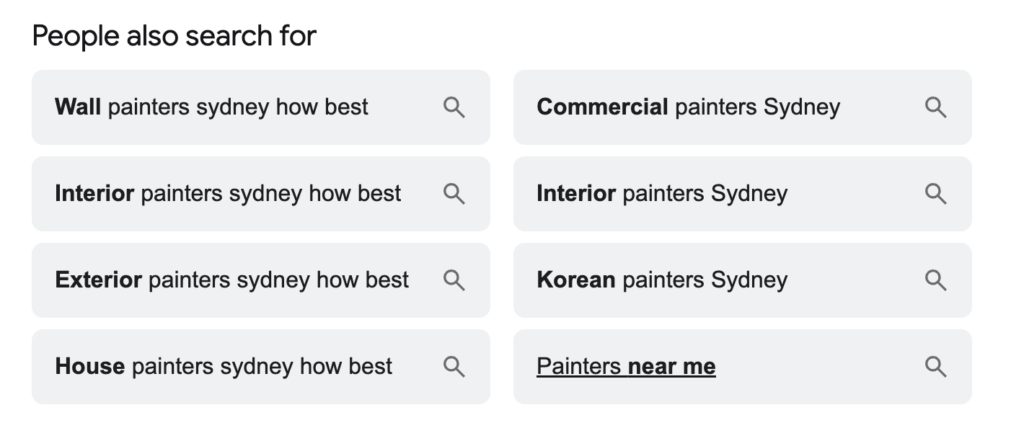
These resources can help you discover the questions, concerns and topics your potential customers are interested in.
But here’s the important part.
Don’t simply copy those questions into an AI tool and ask it to write another generic 1,500-word article.
Use those questions as inspiration for your next documentary.
Let’s imagine you operate a building or renovation company.
One of the questions people commonly research is:
“How much does a bathroom renovation cost?”
A conventional SEO strategy might involve publishing an article outlining estimated costs, materials and labour.
There’s nothing inherently wrong with that.
But imagine taking it further.
You’re about to renovate a customer’s bathroom.
Why not document the entire project?
Film the bathroom before work begins.
Explain the customer’s objectives and budget.
Show the demolition process, waterproofing, tiling and installation.
Discuss unexpected challenges and the decisions you make.
Explain where costs can increase and how homeowners can make informed choices.
Finally, showcase the finished bathroom and, with permission, interview the customer.
You’ve now created something considerably more interesting than another generic renovation article.
You’ve produced original, experience-led content demonstrating your expertise in the real world.
And that gives us multiple opportunities for SEO, social media and brand discovery.
This is one of my favourite aspects of the Small Business Influencer Mindset.
Instead of treating SEO, social media and video marketing as completely separate activities, we can develop an integrated content strategy.
Using our bathroom renovation example, one project could produce:
| Content Asset | Marketing Opportunity |
| SEO Blog article | Answer renovation cost questions and capture relevant organic searches |
| YouTube documentary | Demonstrate the complete renovation process |
| Instagram Reels | Share before-and-after footage and interesting project moments |
| TikTok videos | Explain common renovation mistakes and practical advice |
| LinkedIn post | Share the business lessons or project management challenges |
| Customer case study | Demonstrate experience, results and customer satisfaction |
| Original photography | Strengthen website content and provide unique visual assets |
| Frequently asked questions | Answer genuine customer concerns and support relevant service pages |
And importantly, these assets can support one another.
Your SEO article can embed the documentary.
Your social media posts can direct interested viewers to your website.
Your case study can link contextually to relevant service pages.
Your videos can answer specific customer questions and introduce your expertise to new audiences.
You’re no longer creating disconnected pieces of marketing content.
You’re building a connected ecosystem around your brand.
Let me share another example from an industry I’ve specialised in for more than 16 years.
Jewellery.
I recently saw an Instagram story from Sam at Paul Bram about a beautiful two-carat cushion-cut diamond ring that sold just two days after it was purchased for stock.
I loved the storytelling approach.
Why?
Because it wasn’t simply another photograph of an engagement ring accompanied by a sales message.
It was a real business story.
A beautiful diamond.
A decision to acquire it.
And an incredibly quick sale.
That creates curiosity.
Why was this particular diamond so desirable?
What makes cushion-cut diamonds special?
What should someone consider when purchasing a two-carat cushion-cut engagement ring?
How do jewellers assess the quality and characteristics of a diamond?
What influences the price?
Suddenly, one genuine business experience provides inspiration for an entire collection of useful content.
Imagine developing a detailed article titled:
“Why Are Cushion-Cut Diamond Engagement Rings So Popular? A Jeweller’s Perspective”
Rather than relying entirely on general information, the jeweller could share the experience of selecting and selling that particular diamond.
They could explain the cut, proportions, visual characteristics and customer preferences.
They could film the diamond under different lighting conditions.
They could demonstrate how the stone looks in various settings.
And they could share the professional considerations involved in selecting a beautiful cushion-cut diamond.
From there, we can research relevant search queries and build supporting articles around genuine customer interests.
This approach combines:
Search intent + first-hand expertise + original storytelling + video content.
That’s the kind of content strategy I love developing.
And it works particularly well in industries where purchasing decisions involve significant research, trust and emotional investment.
I often explain the relationship between SEO and social media this way.
SEO helps capture existing demand.
Someone searches for a product, service, question or problem.
Your website has an opportunity to appear when its content is relevant and competitive.
Social media can help generate awareness and future demand.
Someone might not be looking for an engagement ring today.
But after watching an interesting jeweller explain the craftsmanship behind a beautiful diamond ring, they might remember that business.
They might follow the account.
Share the video.
Recommend the jeweller to a friend.
Or eventually search for that business by name.
This is why I believe storytelling is such an important component of brand building.
You’re giving people a reason to remember your business before they’re ready to buy.
And when the time comes, you want your brand to be one of the first they think of.
Consider the difference between someone searching for:
“Engagement rings Melbourne”
And someone searching specifically for your jewellery business.
The first person is researching a product category.
The second already knows your brand.
Both searches can be valuable, but the second illustrates something particularly important.
Your marketing has helped create brand awareness.
I want businesses to build a presence that encourages more people to search for them directly, not simply compete for the same generic keywords as every competitor.
That’s one of the reasons I see SEO, social media, video and digital PR as complementary brand-building activities.
We’re witnessing significant changes in how people discover businesses and information.
Traditional search engines remain important, while AI-powered experiences are creating additional discovery opportunities.
However, I don’t believe the solution is to abandon SEO in favour of another acronym or chase every new AI trend.
Good AI search optimisation begins with many of the same foundations as good SEO.
Your website still needs to be technically accessible.
Your content needs to be useful, relevant and clearly organised.
Your brand needs to be identifiable.
And your expertise needs to be demonstrated.
This is where original documentary-style content becomes especially interesting.
Consider two businesses publishing articles about bathroom renovations.
The first publishes a generic article assembled from information already available across the internet.
The second publishes a detailed article documenting an actual renovation, including original photographs, video footage, professional explanations, real costs and lessons learned.
Which one offers more original value to the reader?
I’d argue the second.
That doesn’t guarantee higher Google rankings or AI citations. Search engines and AI systems consider numerous signals, and no individual content format guarantees visibility.
But original experiences can make your content more useful, distinctive and worthy of being referenced.
Google’s E-E-A-T framework refers to Experience, Expertise, Authoritativeness and Trustworthiness.
E-E-A-T itself isn’t a single ranking factor.
However, these qualities provide a useful framework for evaluating the credibility and helpfulness of your content.
And documentary-style storytelling gives businesses an opportunity to demonstrate them.
A tradesperson can explain a technical challenge they encountered.
A jeweller can show how a diamond is selected.
A financial professional can explain their approach to common client questions while respecting privacy and regulatory obligations.
A manufacturer can document how products are designed, tested and produced.
These are examples of first-hand experiences that can strengthen the usefulness and credibility of content.
You’re not simply claiming expertise.
You’re demonstrating it.
If I were helping a small business build this strategy from the ground up, I would focus on five stages.
Start with your products, services and customer problems.
Use Google Search Console, keyword research tools, People Also Ask and People Also Search For to identify relevant questions and themes.
Group those questions into logical topics rather than creating a separate thin article for every keyword variation.
Understand the search intent before deciding what content to produce.
Now look at the work your business already has scheduled.
What jobs, projects, customer experiences or interesting activities could you document?
Map these real-world opportunities against your keyword research.
For example, if people are searching for the differences between platinum and white gold, a jeweller could film a professional comparison using actual rings.
This gives you a natural starting point for both video and written content.
You don’t need to turn every project into a television production.
Start with your smartphone.
Capture the important stages of your work.
Explain what you’re doing and why.
Discuss the decisions, challenges and outcomes.
Where appropriate, involve your employees or customers, ensuring you have permission to film and publish identifiable people or private information.
Remember that authenticity is often more valuable than excessive production polish.
This is where we bring everything back to SEO.
Develop a comprehensive article that answers the original search query.
Use your documentary footage to support the explanation.
Include original photographs, expert observations, relevant headings and useful internal links.
Embed the video where it adds value.
Add descriptive titles, transcripts or captions where appropriate, and ensure your important content remains accessible in HTML.
The goal isn’t simply to embed a video and hope Google rewards you.
It’s to create the most useful resource you reasonably can for the intended audience.
Finally, share the story across your relevant marketing channels.
Publish shorter video clips.
Create social media posts.
Share professional insights on LinkedIn.
Use YouTube to host longer educational or documentary content.
And monitor the results.
I would look at organic search impressions and clicks, relevant rankings, video engagement, branded search demand, referral traffic, enquiries and ultimately business outcomes.
Not every video will go viral.
Not every article will rank on page one.
But over time, you’re building a valuable library of original content that demonstrates what your business does and why customers should trust you.
One of the biggest misconceptions about influencer marketing is that influence must be measured by follower counts.
I disagree.
If you’re a local builder, would you rather have 100,000 followers from around the world who will never use your services, or a smaller, engaged audience of homeowners in the areas you serve?
If you’re a specialist jeweller, would you rather generate thousands of meaningless video views or build recognition among people genuinely researching an engagement ring?
Influence should be relevant to your business objectives.
You don’t necessarily need to become famous.
You need to become someone worth listening to in your industry.
Someone whose knowledge is useful.
Whose stories are interesting.
Whose experience is evident.
And whose brand people remember when they need your products or services.
That’s what I want small businesses to work towards.
As I approach my 20th year in SEO, I continue to believe that some of the best long-term marketing opportunities come from combining strong technical foundations with valuable content and genuine brand building.
And one of the most exciting opportunities for small businesses is sitting right in front of them.
Their everyday work.
Their customers.
Their expertise.
Their stories.
You don’t need to manufacture an entirely new personality for social media.
You don’t need to publish endless generic AI-generated articles.
And you certainly don’t need Channel 9 to give your business its own television series.
Become your own documentary filmmaker.
Use Google’s search insights to understand what people want to learn.
Use your real-world experience to answer those questions.
Use video and storytelling to make your expertise engaging.
Use SEO to make your knowledge discoverable.
And use social media to build recognition, relationships and trust.
Because ultimately, we’re not just building websites, rankings and traffic.
We’re building brands that people recognise, remember, trust and actively search for.
That’s the Small Business Influencer Mindset.
And it’s an approach I’d love to see more Australian small businesses embrace.
Let me leave you with one question:
If Channel 9 called you tomorrow and offered your business its own documentary series, what would your first episode be about?