A client recently approached me asking why their Google rankings and organic search traffic had declined.
They wanted me to investigate what had gone wrong.
Fair enough. That’s what I do.
But there was something interesting about the conversation.
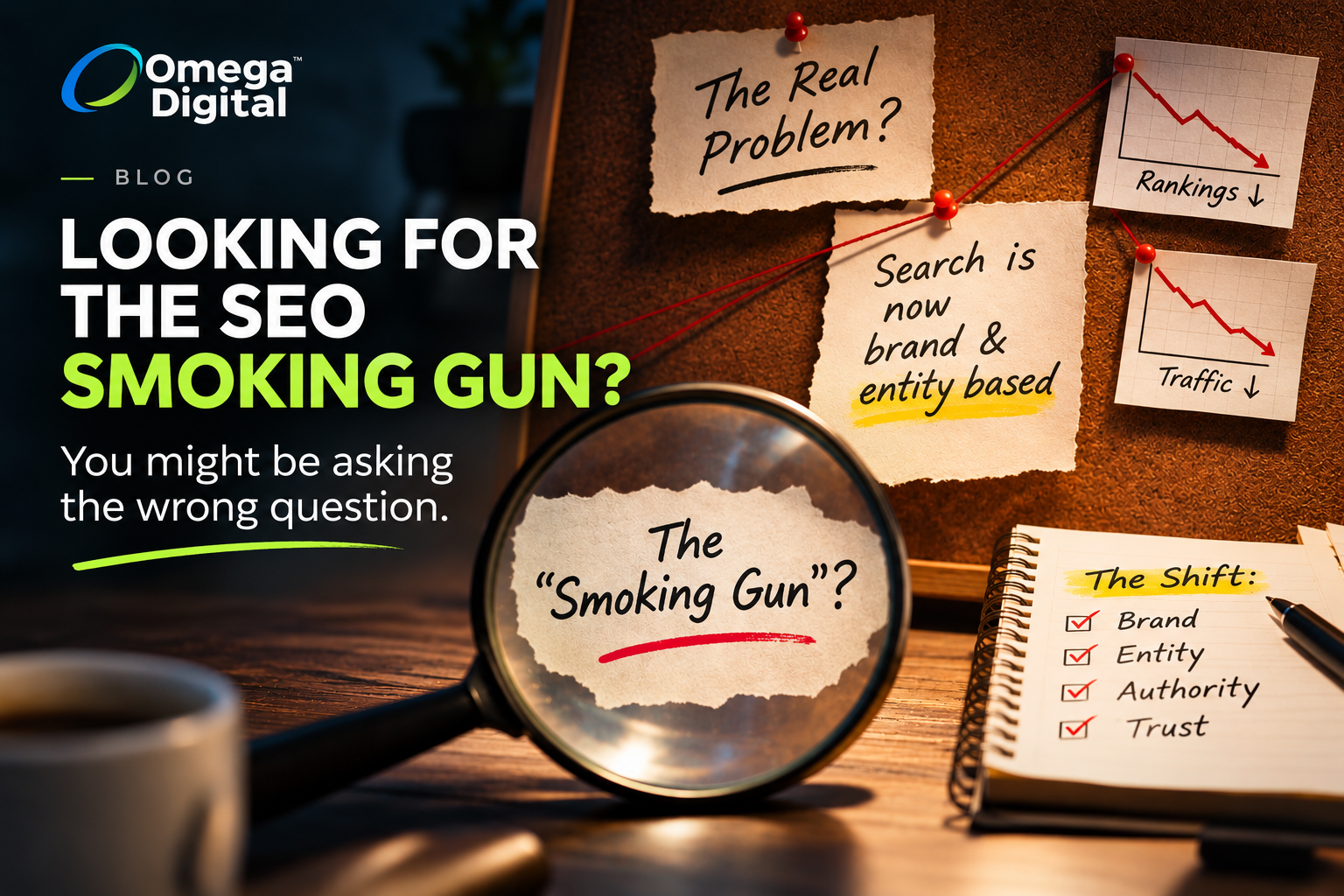
They were looking for the smoking gun.
That one issue. That one technical problem. That one thing previous SEO agencies had somehow missed that would explain why their website was no longer performing as it once did.
And apparently, no other agency had been able to find it.
Now, after almost 20 years working in SEO, I’ve had plenty of these conversations.
And sometimes there really is a smoking gun.
A poorly executed website migration. Incorrect canonical tags. Important pages accidentally blocked from indexing. A technical change that has completely destroyed a website’s organic visibility.
I’ve seen them all.
But sometimes, the reason nobody can find the smoking gun is because there isn’t one.
And perhaps we’re asking the wrong question.
One of the biggest challenges I face when speaking with businesses about SEO is that many are still thinking about Google the way it worked five or ten years ago.
And I understand why.
For years, SEO was largely about identifying the right keywords, creating relevant content, building links, improving technical performance and climbing the rankings.
Do those things still matter?
Absolutely.
But the search landscape heading into 2027 is very different.
We have AI Overviews, AI-powered search experiences, increasingly competitive search results and a much greater emphasis on brands, entities, reputation and authority.
Google is not simply looking at whether your page contains the right keywords.
It’s trying to understand who you are, what your business represents, how relevant you are to a particular search and whether there are enough signals to trust you.
And this is where I think many businesses are falling behind.
They’re still trying to fix yesterday’s SEO problems in today’s search environment.
This is the question I would encourage more business owners to consider.
What if your website is technically sound?
What if your content is reasonably well optimised?
What if your internal linking, metadata, headings and URL structure are all in good shape?
What if there’s nothing fundamentally wrong with the website at all?
That doesn’t mean there isn’t room for improvement. There always is.
But what if your competitors have simply moved ahead of you?
What if they’ve invested more heavily in their brand?
What if they’re being mentioned in industry publications, appearing in interviews, earning editorial backlinks, publishing original research and building a stronger reputation outside their own websites?
And what if Google is recognising those signals?
You can spend months looking for a technical SEO problem that doesn’t exist while your competitors continue building their authority.
That’s a dangerous position to be in.
I’ve been talking a lot lately about brand entities and their importance to SEO and AI visibility.
And I think this is something businesses need to take seriously heading into 2027.
Your website is only one part of your online presence.
Your brand exists beyond your domain name.
It’s what people say about you, where your business is mentioned, who references your expertise, what publications feature you and how consistently your business is represented across the internet.
This is why I believe Digital PR, brand building and reputation management need to become much bigger parts of an SEO strategy.
Not because technical SEO is dead.
Far from it.
But because having a technically excellent website doesn’t automatically make you the most authoritative business in your industry.
And producing another 50 blog articles isn’t necessarily going to solve that problem either.
The web doesn’t need more content for the sake of more content.
It needs better information, original thinking, genuine expertise and businesses willing to demonstrate why they deserve to be trusted.
When a client tells me their organic traffic has declined, of course I want to investigate.
I’ll look at Google Search Console, analytics, indexing, technical issues, search intent, keyword movements and what competitors are doing.
I’ll investigate whether Google has changed how it presents results for the searches that matter to the business.
And yes, I’ll look for that smoking gun.
But I also want to ask a different question.
What have your competitors been doing over the past two or three years that you haven’t?
Because sometimes the answer isn’t hiding in your website’s source code.
It’s happening everywhere else.
And while you’re trying to work out why you dropped from position three to position seven, your competitors might be investing in the very things that will make them harder to displace over the next five years.
I’ve been doing SEO since 2006.
I’ve seen businesses lose rankings because of technical disasters, poor decisions, algorithm updates and aggressive competitors.
And I’ve seen businesses spend enormous amounts of money trying to recover traffic without ever properly understanding why they lost it.
The biggest mistake, in my opinion, is assuming that every decline must have a single identifiable cause.
Sometimes it does.
Sometimes it’s a combination of things.
And sometimes the market, the competition and the search engine itself have changed around you.
That’s why I don’t believe an SEO audit should simply be a list of everything that’s wrong with your website.
It should also tell you what has changed, where your competitors are winning and what your business needs to do next.
Because finding problems is only one part of SEO.
Understanding the bigger picture is where experience comes in.
If your organic search performance is declining, don’t ignore it.
Investigate it properly.
Look at the data. Challenge assumptions. Review the technical foundations. Understand the competition.
But don’t become so obsessed with finding one broken thing that you overlook everything else.
The question shouldn’t simply be:
What’s wrong with my website?
It should also be:
What do we need to become as a brand to compete in search in 2027 and beyond?
That’s a very different conversation.
And perhaps it’s the conversation we should have been having all along.
Andrew P Glyntzos
Managing Director, Omega Digital
Celebrating 20 Years in SEO.
Are You Paying for Experience or Agency Overheads?